














You built the website. You paid someone to design it. It looks clean, loads fine on your phone, and you’re proud of it. But when you type your own business into Google… nothing. Or worse, you show up on page three, buried under a competitor you’ve never heard of.
In Edmonton, this isn’t unusual. The city’s search landscape has gotten complicated fast. It’s not just Google rankings anymore; it’s Google Maps, AI Overviews, ChatGPT recommendations, and a dozen other surfaces where customers are actively looking for businesses like yours. If you’re invisible on even one of them, you’re losing calls. Real ones, right now.
This guide breaks down exactly why, and what to actually do about it.
4 Technical Reasons Your Edmonton Website Can’t Be Found
Here’s the facts about why your brand’s site is not getting visibility…
1. Google Doesn’t Know You Exist Yet (The Indexing Gap)
There’s a difference most business owners don’t know about: being indexed and being ranked are two completely separate things. Indexing means Google knows your site exists. Ranking means Google thinks you’re relevant enough to show someone. You can’t rank if you’re not indexed, but plenty of Edmonton businesses aren’t indexed at all.
This happens more than you’d think. A new site in a developing Edmonton neighbourhood like Keswick, Glenridding, Windermere might sit unnoticed for weeks because Google hasn’t crawled it yet. Or it has a robots.txt file that’s accidentally blocking crawlers. Or a noindex tag left over from the developer’s staging environment. Or a sitemap that was never submitted to Google Search Console.
Go to Google right now and type: site:yourdomain.ca. If nothing comes back, Google doesn’t know you exist. That’s your first fix, and it costs nothing. Submit your sitemap through Google Search Console, request indexing for your key pages, and check your robots.txt file. Fix the indexing problem before you spend a dollar on anything else.
2. Core Web Vitals Are Silently Killing Your Rankings
In Edmonton’s most competitive industries like trades, legal, healthcare, real estate, etc, the margin between getting the call and losing it can come down to three seconds. Literally, Google’s Core Web Vitals measure how fast your site loads, how quickly it responds to a click, and how stable the layout is while it’s loading. Sites that fail these benchmarks get demoted. Quietly, without a warning email.
And the mobile piece matters especially in Edmonton. Over 60% of Canadian search traffic is on a phone, which means Google is ranking you based on how your mobile site performs, not your desktop version. A site that looks gorgeous on a MacBook but loads in 7 seconds on a Samsung in Mill Woods is a site that’s losing rankings every single day.
You can check your own score for free at PageSpeed Insights. Type in your URL and see exactly what’s slowing you down. Common culprits: uncompressed images, render-blocking scripts, cheap shared hosting. These aren’t glamorous fixes, but they’re the ones that move the needle.
3. Your On-Page Signals Don’t Say ‘Edmonton’
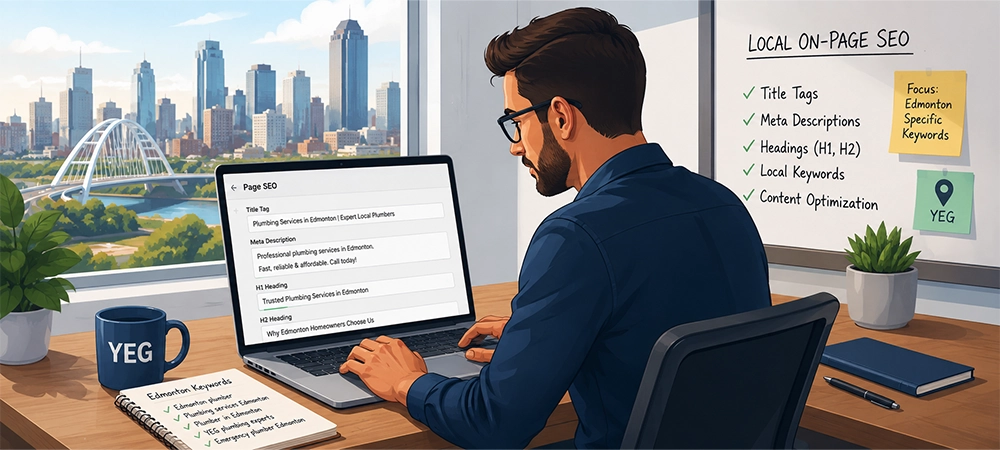
This one’s almost embarrassingly simple, and it’s everywhere. A site that says ‘plumbing services’ in its title tag instead of ‘plumbing services in Edmonton, AB’ is invisible for local intent. Google needs geographic signals to connect your business to Edmonton searches. Not just the city name dropped once in the footer, in your title tags, H1s, service page copy, and URL structure.
And it goes deeper than just ‘Edmonton’. Someone searching for a contractor in Strathcona isn’t using the same language as someone in St. Albert. Neighbourhood-level signals like Whyte Ave, Oliver, Glenora, Sherwood Park… matter more as searches get more specific. If your service pages don’t reflect where you actually work, Google has no reason to show you to people in those areas.
4. You’re Competing With Yourself (Duplicate Content and Keyword Cannibalization)
It quietly tanks a lot of sites. Keyword cannibalization happens when multiple pages on your website all target the same search term. If you have three service pages all going after ‘Edmonton electrician’, they don’t multiply your chances; they split your authority three ways and confuse Google about which one to show.
One well-built, comprehensive page beats three thin ones every time. The fix is a content audit: look at what you have, consolidate what’s overlapping, and build internal links that point Google toward the page you want to rank. That’s also where your marketing analytics setup matters; if you’re not tracking which pages are getting impressions vs. clicks, you won’t know where the cannibalization is happening.
How to Get Your Brand Found on Google Maps, AI Overviews, and Local Search in Edmonton
Here are the key steps to follow to be mentioned by AI overviews, LLMs, and local search.
Your Google Business Profile Is Your Most Valuable Edmonton Asset
If the organic search fixes are your long game, your Google Business Profile (GBP) is your short game. It’s the fastest path to visibility in Edmonton’s local search results, and most businesses are leaving it half-finished.
The primary category is the biggest lever most people don’t pull. This single field has a disproportionate impact on which searches you appear for. ‘General contractor’ and ‘renovation contractor’ are different categories with different search pools. Getting it right, and adding the right secondary categories, is the difference between showing up in the map pack and being invisible in it.
Beyond category: your service area setup matters if you cover the Edmonton metro, not just one address. A business serving both Beaumont and downtown Edmonton needs a service area configured, not just a pin drop. Photos need to be added regularly, not once when you set up the profile. And your hours have to be accurate. Only 12% of Edmonton businesses maintain correct hours on Google. That means 88% are sending frustrated customers to a competitor when they show up and find the door closed.
A properly managed Google Business Profile doesn’t just help you rank in Maps; it feeds the data that AI tools use to recommend you. Which brings us to the part most agencies in Edmonton aren’t talking about yet.
Edmonton Citations That Google and AI Tools Actually Trust
Every SEO post tells you to ‘build citations’. Almost none of them tell you which ones actually matter in Edmonton specifically.
Generic national directories (Yellow Pages, Yelp, BBB) are table stakes; you need them, but they don’t differentiate you. What moves the needle in Edmonton is building citations in local and regional sources: the Edmonton Chamber of Commerce business directory, Explore Edmonton, Alberta Blue Book, the Edmonton Economic Development listings, and industry associations tied to your sector in Alberta. These sources carry local relevance signals that tell Google and AI systems: this business is real, it’s in Edmonton, and trusted local institutions recognize it.
The other thing that breaks citations silently: inconsistency. Your name, address, and phone number need to be identical everywhere, not ‘close enough’. ‘St.’ versus ‘Street’, a suite number missing from one directory, an old phone number on a listing you forgot about. These discrepancies don’t just confuse Google; they make AI tools less likely to confidently recommend you because the data doesn’t add up. A proper link-building and citation strategy cleans all of this up systematically.
How to Show Up When Edmonton Customers Use AI Search
This is the part no one in Edmonton is writing about clearly, so let’s actually talk about it.
When someone opens ChatGPT or Perplexity and types ‘who’s the best roofer in Edmonton?’ or ‘what’s a good accountant near Oliver?’, the answer doesn’t come from a Google ranking. It comes from what those AI systems have learned to trust. And what they’ve learned to trust comes from a combination of signals: review volume and quality, structured data on your website (schema markup), content that directly answers the questions people in Edmonton are actually asking, and consistent entity information across the web.
Schema markup is the piece most Edmonton sites are completely missing. It’s a block of code on your website that tells AI systems and search engines: this is a LocalBusiness, here’s the address, here’s the phone number, here’s the category, here are the services. Without it, you’re relying on Google and AI to guess. With it, you’re telling them directly. It takes a developer maybe two hours to implement, and it’s one of the fastest wins available for local visibility right now.
Content matters too, but not the way most people think. AI tools don’t pull from keyword-stuffed service pages. They pull from content that actually answers questions in natural language, the kind of content that sounds like a knowledgeable local wrote it, not a page that exists to rank.
An Edmonton plumber who has a blog post explaining ‘what to do when your basement floods in winter in Edmonton’ is a more trustworthy source to an AI than a service page that just says ‘Edmonton plumber’ fifteen times. This is the exact type of SEO strategy that compounds; it works for traditional Google rankings, for AI Overviews, and for ChatGPT recommendations all at once.

The Review Gap That’s Costing Edmonton Businesses Map Pack Rankings
Here’s a data point that should change how you think about reviews: Edmonton businesses average 4.9 Google reviews. Toronto and Vancouver businesses average 39. That’s not a small gap; that’s a completely different ballgame.
In the Google Map Pack, review count and review recency are direct ranking signals. An Edmonton competitor with 45 detailed reviews will outrank you in the map pack almost every time, even if your website is technically stronger. And AI tools lean on reviews too; they’re one of the clearest signals that a real business exists, serves real customers, and delivers on what it promises.
The fix isn’t complicated, but it requires consistency. Ask every customer, every time. Make it easy, send a direct link, not a generic ‘please review us’ request. Respond to every review you get, including the negative ones. Review velocity (getting them regularly over time) matters more than getting twenty in a week and then nothing. And quality matters: a detailed review that mentions your service, your location in Edmonton, and a specific outcome is worth more than five one-star ratings with no text.
If you want to see exactly where your review profile stands compared to competitors in your specific Edmonton neighbourhood, a proper SEO audit will show you the gap and the exact steps to close it.