














Your business in New York has a website. It loads. It looks professional. You showed it to a few people, and they said something nice about it. And yet — the contact form sits empty. The phone doesn’t ring from online searches. A competitor you’ve seen around, with a site that honestly looks worse than yours, is busier than you are.
NYC buyers are fast, skeptical, and always one tap away from your competitor. They’ve been burned before. They comparison-shop instinctively. And in 2026, they’re not just finding you on Google; they’re asking ChatGPT, checking AI Overviews, and making decisions during a subway commute on a phone screen that’s showing them everything above the fold and nothing below it.
The web design conversation has changed. This is what it actually takes to convert in New York right now.
4 Real Reasons a New York Business Website Fails to Generate Leads
The following are the causes of poor lead generation for New York businesses.
1. It’s Not Found (The Visibility Problem That Precedes Everything Else)
You can’t convert traffic that doesn’t exist. And in New York City, where every competitive search result is packed with aggregators (Yelp, Angi, Thumbtack, HomeAdvisor), paid ads, Google’s local pack, and organic results all fighting for the same vertical strip of screen, just having a website is not the same as being visible.
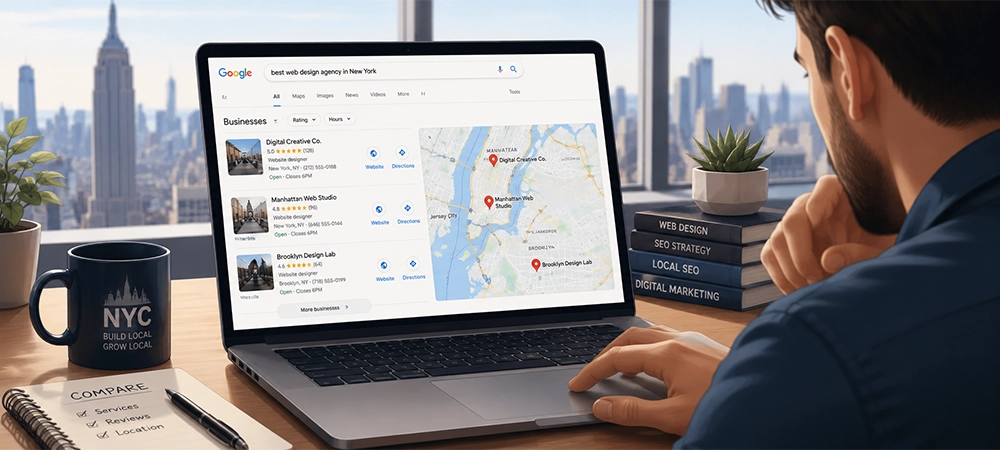
In 2026, that visibility question extends beyond Google rankings. When someone in Manhattan types ‘best web design agency in New York’ into ChatGPT or uses Google’s AI Overview, the answer they see gets assembled from businesses with strong entity signals: complete and accurate Google Business Profiles, consistent name and address data across local directories, schema markup that tells AI systems exactly what you offer and where you offer it, and content that answers the specific questions NYC buyers are asking. Without these, you’re invisible on the surfaces that are increasingly driving first contact.
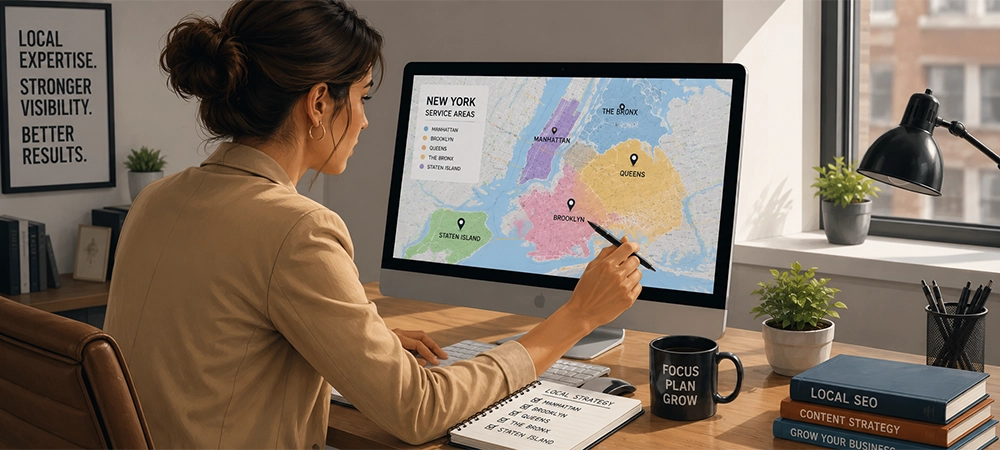
A New York service page that says ‘we serve clients in New York’ is not a local SEO strategy. Neighbourhood-level content–Chelsea, Midtown, Brooklyn, Queens, the Bronx, Staten Island, with specific context for each area is what tells both Google and AI tools that you’re genuinely embedded in those markets, not just a business with a New York address. That’s what the right SEO strategy builds.
2. It’s Slow on Mobile, and NYC Buyers Don’t Wait
Over 60% of web searches in the US happen on mobile. In New York specifically, where a massive portion of the population commutes by subway and does everything on a phone during that commute, that number is arguably higher in practice. Your mobile experience isn’t a nice-to-have. It’s the primary context in which most of your potential customers first encounter you.
Google’s Core Web Vitals measure three things that matter for your mobile ranking: how fast the largest element on your page loads (LCP, should be under 2.5 seconds), how much the layout shifts while loading (CLS, should be near zero, because shifting content makes people click the wrong thing and leave frustrated), and how quickly your page responds to a tap (INP, should be under 200 milliseconds). Sites that fail these benchmarks get quietly demoted.
On LTE or 5G in the subway, a site that takes 5 seconds to render loses that potential customer. They didn’t close the tab out of impatience; they closed it because they’ve learned, from years of browsing on a phone in New York, that slow sites usually mean slow businesses. It’s an unfair association, but it’s real. Site speed is brand perception in NYC.
Your web design should be built mobile-first, not designed for desktop and then scaled down.
3. It Doesn’t Build Trust Fast Enough for NYC’s Skeptical Buyers
New York buyers are not like buyers in most other markets. They’ve been pitched before. They know what a generic website looks like. And when they land on yours, they’re scanning, not reading, for signals that tell them you’re real, you’re experienced, and you’ve done this for someone like them.
The trust signals that actually convert in NYC are specific. Not ‘we’ve served 500+ clients’ — but a case study from a named law firm in Midtown, or a before-and-after for a contractor in Brooklyn, or a testimonial from a restaurant owner on the Upper West Side. The more New York it is, the more it lands. Generic credibility claims get ignored because NYC buyers have seen them everywhere. Specific, verifiable, local proof gets attention.
Real team pages with LinkedIn profiles matter here in a way they don’t always elsewhere. Press mentions from New York publications, even local ones, matter. Third-party review badges from Google, Clutch, or the BBB matter. If your website looks like it could belong to a business in any city, it’s not working hard enough for New York. Your web design needs to be unmistakably local.
4. The CTA Architecture Is Wrong for Service Businesses
This is one of those things that sounds simple until you start counting how many service business websites in New York violate it constantly: one primary CTA per page. Not three. Not five. One.
When a potential client lands on your services page and sees ‘Book a Call’, ‘Download Our Guide’, ‘View Case Studies’, ‘See Pricing’, and ‘Subscribe to Our Newsletter’ all competing for their attention, they feel the friction and leave. Decision paralysis is real, and NYC buyers who have six competitor tabs open will choose the path of least resistance.
For service businesses in New York: your homepage primary CTA should be one action (book a call, request a quote, get a free audit). Your contact form should have four fields or fewer: name, email, phone, message. And after someone submits that form, the next page should tell them exactly what happens: ‘We’ll call you within 2 business hours’. Not ‘thank you for your submission’.
Tell them what to expect, because NYC buyers want to know they’re dealing with an organized, responsive business.
What the Right New York Web Design Agency Actually Fixes
Building for AI Search, Not Just Google Rankings
Most web design agencies in New York will talk about SEO. Fewer will talk about GEO, Generative Engine Optimization, which is the practice of building your site to be cited and recommended by AI tools like ChatGPT, Perplexity, and Google’s AI Overviews.
The difference matters. Traditional SEO optimizes for a ranking algorithm. GEO optimizes for systems that read your content, decide if you’re trustworthy, and then synthesize recommendations.
For business, that means: LocalBusiness schema markup on every location page so AI tools know exactly who and where you are; FAQ schema that answers the questions NYC buyers are actually typing into AI search (‘how much does web design cost in New York’, ‘what should I look for in a NYC web design agency’); and content written by someone who clearly knows the New York market, not content that uses ‘New York’ as a keyword and leaves it at that.
An agency that’s still thinking about web design as a design problem, not a visibility and trust architecture problem, is not going to build you a site that performs in 2026.
The Speed-to-Response System, Because Design Ends When the Form Is Submitted
Here’s the part no web design agency talks about, and it’s the one that might be costing you more than anything else on this list.
Harvard Business Review published research showing that web leads contacted within an hour are 7 times more likely to convert than leads contacted after an hour. Here, where your potential client has three other browser tabs open with your competitors’ sites, that window might actually be shorter. A form submission that goes unanswered for 4 hours, or overnight, is almost always a lead that hired someone else.
A complete lead generation system doesn’t end at the form. It includes an auto-reply email that confirms receipt and sets expectations (‘we’ll be in touch within 2 hours’); an internal notification that reaches the right person immediately (email, Slack, SMS — whatever your team actually monitors); and a short follow-up sequence for leads that don’t respond to the first outreach. Most web design agencies build the form and hand you the keys. The full system is what the ones worth hiring actually deliver. That’s what conversion-focused web design means in practice.
Neighborhood-Level Content That Converts NYC’s Hyper-Local Searches
‘Web design agency New York’ is a hard keyword to rank for. Not impossible, but it’s competing against national agencies with large domain authority. ‘Web design agency for restaurants in Brooklyn’ is a different search entirely, more specific, higher intent, less competition, and more likely to convert because the person searching it has already narrowed their decision.
Service pages built around New York’s boroughs and neighbourhoods don’t just help with SEO; they tell your potential client that you understand their market. A contractor in Astoria searches differently than a contractor in Tribeca. A law firm in Midtown has different needs than a boutique in Bushwick. Content that speaks to those specific contexts converts at a higher rate than generic ‘we serve New York businesses’ copy, because the reader feels seen rather than processed.
A smart SEO and content strategy for a NYC business includes at least borough-level pages, and ideally neighbourhood-level content in your highest-value service areas. It’s not more work for the sake of it; it’s targeting the searches where you can actually win.
Conversion Rate Optimization Is Part of Web Design, Not a Separate Service
A lot of web design agencies will build your site, launch it, and then six months later suggest you need a CRO (conversion rate optimization) engagement to figure out why it’s not converting. That is backwards. Conversion thinking should be in the design from day one.
For reference: average website conversion rates for NYC service businesses run roughly 2-4% for professional services (law, accounting, consulting), 3-5% for home services and contractors, and 1-2% for B2B technology companies. If you don’t know your current conversion rate, you can’t improve it. Go to Google Analytics 4, set up a conversion event for your form submission, and divide that number by your total sessions. If you’re at 0.5% on a service page, that’s the number you’re trying to move, and there’s almost always a specific reason it’s that low that shows up in the session recordings.
Headline testing, CTA button copy, form field count, above-the-fold layout on mobile- these are the levers. Your web design agency should be pulling them as part of the engagement, not treating them as optional extras. Marketing analytics that track these numbers should come standard, not as an upgrade.